Ankle supports of this type are built from textile yarns chosen for stretch, recovery and contact against the skin. Elastic filaments are combined with companion fibres so the fabric can expand over the heel and then settle around the ankle. Yarn selection sets the baseline for how soft the sleeve feels, how far it stretches and whether it returns after repeated wear. Unsuitable yarns produce tubes that either bag out quickly or grip too harshly. Material choice is therefore matched to the intended structure: a close, flexible sleeve rather than a rigid shell. Product specifications define the actual blend; manufacturing follows those specifications so that successive lots behave alike on the body.
Selected yarns are creel-fed to a circular knitting machine. Tension, needle condition and course settings are prepared before the run so that the fabric does not vary from start to finish of a roll or garment-length tube. Machine setup is a control point: small drifts in tension show up later as uneven circumference or weak courses. Consistent preparation keeps the knitted body within the dimensional band required for sizing.
Circular knitting builds a continuous tube as needles work around a cylinder. That tube becomes the main body of the ankle support—an already rounded sleeve that needs little side seaming compared with cut-and-sewn panels. Stitch pattern and density define thickness, openness and directional stretch. The knitted construction is what will later wrap the ankle in one piece, so course count and diameter are aimed at the target size range from the outset.
Yarn character and knitting settings together govern stretch and recovery. More elastic content or different loop geometry changes how firmly the sleeve holds and how easily it pulls on. Consistent construction across the tube matters for fit: a support that is tight at the top and loose at the bottom will migrate during walking. Process control at the machine is the quality gate for ankle coverage that stays even. A Small Ankle Support size band still depends on that same disciplined knitting, only at a smaller finished circumference.
Tubular fabric is cut or shaped to the length and edge profile required by the design. Openings for the heel or foot entry, if any, are formed according to the pattern. Dimensional checks at this stage catch tubes that have drifted outside tolerance before value is added in later steps. Maintaining structural consistency here protects the fit that the knit was built to deliver.
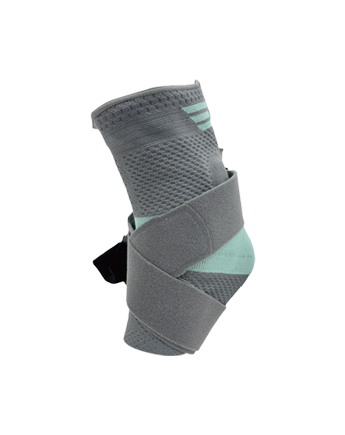
Adjustable straps are attached to the knitted body at marked positions. Placement affects both how the user reaches the fasteners and how tension wraps the ankle when the straps are set. Stitching, welding or other attachment methods must hold under pull without tearing the knit. Strap hardware—hooks, loops or similar—is chosen to operate easily yet resist accidental release during ordinary movement. This step turns a plain elastic sleeve into an Ankle Support Adjustable product with user-controlled tension.
Edges are cleaned or bound so that they do not unravel or abrade the skin. Labels, size marks and any required identifiers are applied. Final assembly confirms that straps, body and closures form one coherent unit. Neat edges, secure strap roots and even appearance are finishing standards that also affect comfort and durability in daily use.
Inspectors look at stitch uniformity, surface appearance and basic dimensions against the standard for the size. Holes, runs or heavy variation in density are rejected because they change local stretch and can open further in wear. Consistent knitted construction is the foundation of predictable fit across a batch.
Sample sleeves are stretched and allowed to recover according to internal methods matched to the product. Results indicate whether the knitted body will still hug the ankle after repeated donning rather than remaining elongated. These checks link machine settings to the wearing characteristics users notice after a week of use.
Strap attachment strength, fastener function and adjustment travel are verified. Loose bartacks, skewed straps or weak closures fail the unit even if the knit is perfect. Secure assembly and consistent finishing are what make the adjustable feature reliable rather than decorative. An Adjustable Ankle Stabilizer style product depends on both the textile and the strap system passing these inspections.
The product’s body is a circular knitted tube whose structure supplies flexible ankle coverage with limited bulk. That construction is the comfort and fit base before any strap is added.
Straps are combined with the knitted body so that textile manufacturing and practical adjustment sit in one item. Users gain elastic coverage plus the ability to tune hold after the sleeve is on.
Fabric consistency, strap attachment quality and finished inspection work together. Manufacturing quality shows up as even fit, dependable strap action and tidy edges in everyday use—not only as a clean sample on a table.
| Stage | Main activity | Quality focus |
|---|---|---|
| Material selection | Yarns for stretch, recovery, skin contact | Match to product specification |
| Machine setup and knitting | Tubular fabric formation | Tension, density, dimensional stability |
| Shaping and cutting | Length and openings | Size accuracy; clean edges |
| Strap attachment | Fix adjustable straps to body | Position; strength; fastener function |
| Finishing | Edges, labels, final assembly | Appearance; secure construction |
| Inspection | Fabric, elasticity, straps | Fit-related and functional checks |
Circular knitting ankle supports are manufactured by selecting suitable yarns, knitting a controlled tubular fabric, shaping the sleeve, attaching adjustable straps and finishing the assembly under inspection for structure, stretch recovery and strap security. The Circular Knitting Ankle Support with Adjustable Straps pairs that knitted body with strap-based fit control for daily wear. Zhejiang Steriger Sports Medicine Technology Co., Ltd. produces knitted ankle supports including circular-knit designs with adjustable straps. Review of material specification, knitting consistency, strap design and inspection practice against sizing and comfort requirements supports reliable production of supports intended for regular use.
Steriger is a national high-tech enterprise specializing in the R&D and production of high-quality sports supports, medical braces, and sports compression socks.
Copyright © Zhejiang Steriger Sports Medicine Technology Co., Ltd.
The information provided on this website is intended for use only in countries and jurisdictions outside of the People's Republic of China.

Approval No: 浙金药监械生产备20200039号

 English
 Español
 Deutsch
 عربى
 Français