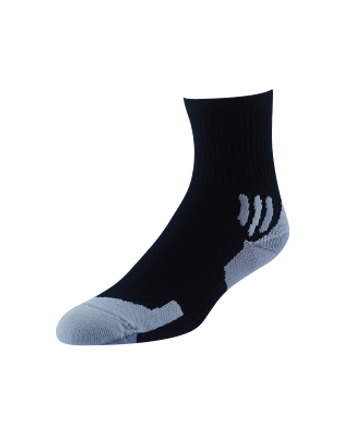
Basketball involves repeated acceleration, abrupt stops, jumps and rapid changes of direction. Each of these actions generates forces that can slide the foot forward, backward or sideways inside the shoe. When that movement becomes excessive, the result is rubbing, hot spots and a feeling that the foot is not fully locked in place. Socks that incorporate targeted grip surfaces and a secure fit form one part of the solution, working together with properly fitted shoes rather than replacing them. Comfy Non Slip Socks designed for court use therefore address the interface between skin and insole when size, thickness and grip pattern are matched to the footwear and the individual foot.
A hard drive toward the basket or a sharp lateral cut loads the shoe in one direction while the foot tends to continue in another. The same separation of motion occurs on landing from a rebound or when planting to change direction. These forces are inherent to the game and appear in both practice and competition.
Shoes that are too long or too wide leave empty volume in which the foot can travel. Socks that are oversized or excessively thick can fold or bunch, creating additional free space. Conversely, a sock that is too thin may allow the foot to slide on a smooth insole. No sock can fully correct a shoe that fails to hold the heel or that leaves excessive toe room; the two items must work as a pair.
Even small amounts of sliding, repeated over the course of a session, generate friction against the heel, the sides of the forefoot or the tops of the toes. The resulting heat and abrasion reduce comfort and can distract attention from the play itself. Managing that relative motion therefore matters for both comfort and sustained confidence on the court.
Grip zones placed on the plantar surface of the sock raise the friction coefficient against the shoe's insole. When the foot attempts to slide, the textured contact area resists the displacement. Effectiveness depends on the location and coverage of the grip pattern and on consistent contact with the insole throughout the stride and landing.
A sock that follows the contours of the foot without excess length or circumference limits the fabric's ability to shift independently of the skin. Secure yet comfortable tension around the midfoot and heel keeps the sock from twisting or forming folds that would themselves become sources of movement.
Grip performance is not determined by the sock alone. Insole material, the presence or absence of a removable footbed, sock thickness and the three-dimensional shape of the individual foot all modify the final result. The same sock may feel more or less stable in different shoe models, which is why the combination is evaluated together.
Repeated friction at the heel, the medial or lateral forefoot, or beneath the toes often signals that the foot is travelling inside the shoe. Before changing equipment, the current fit of both shoe and sock is rechecked to isolate the source.
Fabric that rotates around the foot or gathers under the arch indicates that the sock is either the wrong size or constructed in a way that fails to stay aligned. The problem may appear only after several minutes of play as the materials warm and settle.
Players who repeatedly lift the heel, curl the toes or otherwise adjust the foot inside the shoe during breaks in play are often compensating for a lack of secure hold. The behaviour points to a fit or friction issue rather than to a technical flaw in movement.
Heel lockdown, adequate but not excessive toe room, and a secure midfoot wrap form the foundation. Shoes that allow the heel to lift or the foot to slide forward under braking cannot be fully corrected by sock choice alone. Fit is assessed while standing and while performing a few side-to-side movements.
Once shoe fit is confirmed, socks that incorporate plantar grip, appropriate thickness and a reliable size range are selected. The combination is tested in controlled practice so that any remaining movement or pressure points can be identified before competitive use. Over the Calf Basketball Socks that extend higher on the leg may also influence overall security for players who prefer that length, provided the foot portion still delivers the necessary grip and fit.
Grip surfaces flatten with use, elastic recovers less effectively, and fabric can thin or distort. Pairs that have lost their original tension or whose grip zones have become smooth are retired so that the intended friction and fit are restored.
Grip and fit features in court socks complement, rather than substitute for, properly fitted basketball shoes. Players seeking to manage internal movement can examine the grip layout, available sizes, material composition and care instructions of candidate socks to determine whether a given design addresses the specific sliding pattern they experience. The final decision rests on the interaction of sock, shoe and foot rather than on any single product claim.
| Factor or Observation | Relation to Internal Foot Movement | Practical Response |
|---|---|---|
| Rapid acceleration and cutting | Generates forces that displace the foot inside the shoe | Accept as inherent; manage through fit and friction |
| Loose shoe or oversized sock | Creates free volume for sliding and bunching | Confirm heel hold and sock size before other changes |
| Smooth sock-to-insole interface | Allows repeated micro-sliding and friction heat | Introduce plantar grip zones matched to the insole |
| Hot spots or localized rubbing | Indicates repeated relative motion at contact points | Recheck fit; inspect sock condition and grip wear |
| Sock twisting during play | Suggests inadequate contouring or recovery | Select secure sizing; replace stretched pairs |
| Frequent foot readjustment | Compensates for lack of stable hold | Test shoe-and-sock combination in practice |
Foot movement inside basketball shoes arises from the forces of the game, from any excess volume between foot and shoe, and from insufficient friction at the sock–insole interface. Socks that combine a secure fit with purposeful grip surfaces can reduce that sliding when the shoes themselves already hold the foot correctly. Selection proceeds from verified shoe fit, through matching sock size and grip design, to regular replacement of worn pairs. Zhejiang Steriger Sports Medicine Technology Co., Ltd. produces court socks with anti-slip features for basketball and related activity. Review of available grip patterns, size ranges, material constructions and care guidance against individual shoe models and playing demands allows selection of socks that support a more stable interface between foot and footwear.
Steriger is a national high-tech enterprise specializing in the R&D and production of high-quality sports supports, medical braces, and sports compression socks.
Copyright © Zhejiang Steriger Sports Medicine Technology Co., Ltd.
The information provided on this website is intended for use only in countries and jurisdictions outside of the People's Republic of China.

Approval No: 浙金药监械生产备20200039号

 English
 Español
 Deutsch
 عربى
 Français