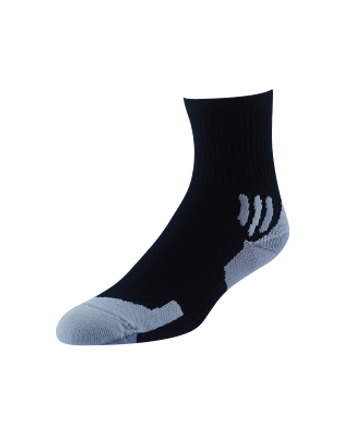
Basketball socks are judged not only by appearance but by how the fabric behaves under repeated stretch, abrasion and moisture. Fiber selection sets the baseline for weight, recovery and surface friction, while knitting density, reinforcement and finishing determine whether that baseline is realized consistently from pair to pair. Product quality therefore emerges from the combination of materials and construction rather than from any single attribute. Comfy Non Slip Socks that incorporate deliberate grip zones and controlled elasticity illustrate how these elements work together when the stated composition matches the actual yarn and when the knit remains uniform across production lots.
Polyester is widely used because it can be spun into lightweight yarns that move moisture away from the skin and dry relatively quickly. The real-world result depends on the specific yarn type, the density of the knit and any subsequent finishing treatments. Two socks labelled as polyester may feel and perform differently if one uses a finer filament and a tighter structure than the other.
Nylon is often blended into high-wear zones or throughout the sock to improve resistance to rubbing against the shoe interior and the court surface. Its presence should be verified in the fiber composition statement rather than assumed from marketing descriptions. The proportion and placement of nylon influence both durability and the hand feel of the finished fabric.
Elastane supplies the recoverable stretch that allows a sock to expand over the foot and then return toward its original dimensions. The amount of elastane and the way it is combined with the main yarns affect how firmly the cuff holds and how well the foot portion resists permanent elongation. Insufficient recovery leads to sagging; excessive tension can create discomfort.
Cotton contributes a soft surface against the skin. Its moisture absorption differs from that of many synthetics, so the overall moisture behaviour of a cotton-blend sock depends on the percentage of cotton and on the accompanying synthetic fibers. Design intent—whether prioritising a soft hand or rapid drying—guides the decision to include cotton and at what level.
The number of stitches in a given area and the tension at which they are formed influence thickness, stretch and surface evenness. Inconsistent density across a sock or between pairs produces visible and tactile variation that becomes apparent once the product is worn and washed. Matching sample density to bulk production is therefore a central quality concern.
These zones experience concentrated abrasion from the shoe and from repeated flexing. Additional yarns or denser knitting can extend service life, provided the reinforcement remains flexible enough to avoid pressure points. The transition between reinforced and standard fabric should be smooth so that the sock continues to follow the foot.
Thicker knit structures under the heel or forefoot can be introduced to alter impact feel. Consistency of thickness within each intended zone matters; patches that vary from pair to pair create uneven pressure and complicate size grading. The location and extent of any cushioning are confirmed against the product specification.
Anti-slip patterns may be applied or knitted into the plantar surface to increase friction against the insole. Placement, coverage and the security of attachment to the base fabric determine whether the grip remains effective after repeated wear and laundering. Not every basketball sock includes such elements; when they are present, their repeatability across pairs is checked rather than taken for granted.
Cuff elastic and any additional elastic yarns in the foot or leg must maintain tension over time. Variation in elastic insertion or in heat-setting can produce pairs that differ in hold even when the nominal size is identical. Recovery after stretch is evaluated both on new samples and after controlled washing cycles when durability data are required.
Toe seams that sit too high or that present a rough ridge can irritate the toes inside a close-fitting shoe. Loose yarns, uneven trimming and incomplete binding affect both comfort and the visual standard of the product. Finished pairs are inspected under consistent lighting so that these defects are caught before shipment.
Areas that feel thinner or denser than the surrounding fabric, or that differ from the approved sample, signal process drift. Buyers who establish measurable or clearly described acceptance limits reduce the chance that such variation reaches the retail or team level.
Untrimmed yarns, measurements outside agreed tolerances and visible flaws in the fabric surface cause to returns and to inconsistent sizing. Defined inspection criteria—rather than subjective visual judgment alone—provide a shared reference for supplier and buyer.
When grip elements are part of the design, shifts in placement, incomplete coverage or weak adhesion create pairs that perform differently from one another. Checking pattern registration and attachment security on multiple samples confirms that the feature is reproducible.
The declared composition, size range, construction notes and any available test references are compared with the physical sample. Discrepancies between description and reality are resolved before production quantities are approved.
Dimensions, stitch appearance, fabric density, finishing quality and, where applicable, grip placement are examined across several pairs. Acceptance criteria are recorded so that later bulk shipments can be judged against the same standard.
Washing trials, shape-retention checks and abrasion assessments—whether performed by the supplier under agreed methods or by the buyer—supply evidence of how the sock will behave after repeated use. Conditions and measurement methods are defined in advance so that results remain comparable.
Inspection frequency, defect classification, packaging requirements and the procedure for addressing lots that differ from the approved sample are established in writing. Clear rules reduce disputes and protect the consistency of the finished goods.
Fiber blend, knit architecture, reinforcement strategy and the presence or absence of grip features together determine whether a sock is positioned for everyday practice, for higher-intensity competition or for a specific price segment. Comfort, durability and cost must be balanced against the expectations of the target retail or team channel. Defining these requirements before specifications are finalised prevents later redesign and mismatched inventory. Over the Calf Basketball Socks that extend coverage up the leg add further variables of elastic tension and fabric recovery along the calf, making consistent construction especially relevant for that length category.
| Aspect | Influence on Finished Quality | Buyer Verification Step |
|---|---|---|
| Fiber composition | Moisture behaviour, abrasion resistance, recovery | Match declared content to sample and data sheet |
| Stitch density and uniformity | Thickness, stretch, visual consistency | Compare sample pairs; set acceptance limits |
| Heel and toe reinforcement | Durability under repeated flex and abrasion | Confirm location, flexibility and transition quality |
| Cushioning and grip elements | Impact feel and resistance to internal foot movement | Check placement, consistency and attachment security |
| Elastic recovery and cuff hold | Shape retention and position during wear | Evaluate stretch and return on new and washed samples |
| Seam and edge finishing | Comfort inside the shoe and visual standard | Inspect for ridge height, loose yarns and trim |
| Production consistency controls | Batch-to-batch uniformity | Agree inspection methods and deviation procedures |
Basketball sock quality rests on the interaction of selected fibers, the architecture of the knit, the reinforcement of high-wear zones and the care taken in finishing. Grip features, when included, add another layer that must be applied consistently. Samples checked against written specifications, durability evaluations and clear production standards reduce the risk of variation once bulk manufacturing begins. Zhejiang Steriger Sports Medicine Technology Co., Ltd. manufactures basketball socks with defined material compositions and controlled knitting processes. Review of fiber content, construction details, size ranges, grip layouts where offered and quality documentation against the intended product position and inspection requirements allows selection of socks that meet both performance and consistency expectations.
Steriger is a national high-tech enterprise specializing in the R&D and production of high-quality sports supports, medical braces, and sports compression socks.
Copyright © Zhejiang Steriger Sports Medicine Technology Co., Ltd.
The information provided on this website is intended for use only in countries and jurisdictions outside of the People's Republic of China.

Approval No: 浙金药监械生产备20200039号

 English
 Español
 Deutsch
 عربى
 Français