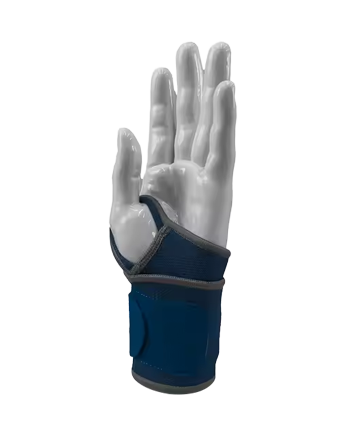
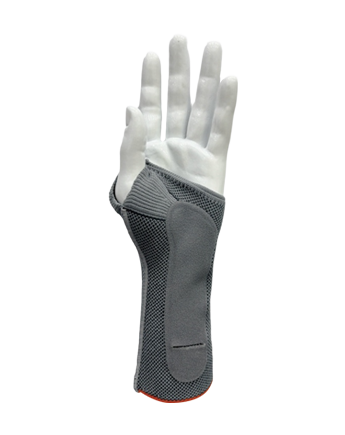
Sleep should be a recovery period. For people dealing with wrist pain, nerve irritation, or hand discomfort, it often isn't — because the positions the hand falls into during sleep work against recovery rather than supporting it. A Palm Brace worn overnight addresses this directly. But only when it fits. And knowing whether it fits correctly is something a lot of users genuinely struggle with.
During waking hours, people naturally adjust how they hold their hands. Discomfort sends a signal, the hand shifts. At night, that feedback loop is gone. The hand ends up in whatever position the body finds comfortable — and that position is often not neutral.
A bent wrist puts pressure on the soft tissue running through the carpal tunnel. It compresses the channel the median nerve passes through. Hold that position for several hours and the result on waking is familiar to a lot of people: numbness, tingling, a hand that needs shaking out before it works properly.
The wrist in a neutral position — roughly flat, neither bent sharply forward nor pulled sharply back — distributes pressure more evenly across the joint. Tendons sit with less tension. The nerve channel stays open. The hand can rest without creating the conditions for irritation.
The challenge is that a neutral wrist position during sleep requires either consistently good posture — which is hard to maintain unconsciously — or something that holds the wrist there regardless of what the rest of the body does. That's the functional case for overnight Palm Brace use.
When tissue around the wrist joint is already inflamed — from repetitive strain, arthritis, or a recent injury — sustained pressure through the night compounds the problem. Swelling that would otherwise reduce during rest is maintained by the compression a bent position creates. A brace that keeps the wrist in a neutral or near-neutral angle during sleep removes that sustained pressure and gives the surrounding tissue a genuine chance to recover.
A standard wrist brace focuses on the wrist joint itself. A Palm Brace extends support higher up — across the metacarpal area, where the hand connects to the wrist. That coverage is relevant overnight because pressure during sleep doesn't isolate neatly to one point. It spreads across the whole hand-to-wrist transition zone.
By holding the palm and wrist together in a supported position, a Palm Brace prevents the compensatory movements that can occur when only one point is stabilized. The hand stays as a unit rather than bending at whichever joint offers less resistance.
Overnight use has a different requirement from daytime use. During the day, some degree of restriction is acceptable — it's part of what makes the brace functional. At night, excessive rigidity creates discomfort that wakes the user or leads them to remove the brace before sleep ends.
Well-designed Palm Braces for overnight use balance light structural support — enough to prevent sharp wrist flexion — with fabric construction that allows the hand to rest without feeling locked. The stay or splint element holds the wrist angle; the surrounding material sits comfortably against the skin over hours.
The clearest signal that a Palm Brace is working overnight is what happens on waking. Users who previously experienced morning numbness, hand stiffness that takes time to resolve, or pain on waking that eases through the day should see a reduction in those symptoms. Not necessarily immediate or complete — but directionally better within a week or two of consistent overnight use.
If morning symptoms are unchanged or worsening after a reasonable period of use, the brace either isn't fitted correctly, isn't the right design for the condition, or isn't staying on through the night.
A well-fitted Palm Brace worn overnight should not be what wakes the user. If they're consistently waking to adjust it, remove it, or relieve discomfort caused by the brace itself, something is wrong with the fit. This is a meaningful feedback signal for retailers and distributors — users who report nighttime discomfort from the brace rather than from the condition it's meant to address have a fit problem, not a product problem.
After a full night with a Palm Brace, the hand should feel supported rather than cramped. Some initial adjustment period is normal — wearing a brace overnight takes getting used to. But if the sensation after a week is still one of restriction rather than relief, the product or fit needs revisiting.
Getting a definitive answer on fit requires checking a few things — not all at once, but systematically. Here's how to work through it.
This is the baseline question. A Palm Brace that has migrated up the forearm, slipped down toward the fingers, or twisted out of position by morning is not fitting correctly.
What to look for:
If the brace moves significantly through the night, the issue is usually that it's slightly too large, the straps aren't tensioned adequately, or the strap configuration isn't suited to overnight movement.
This check splits into two different causes, and the direction matters.
If there's any uncertainty about which cause applies, loosening the straps slightly and observing the change over a few nights usually clarifies it.
After removing a Palm Brace, light indentation from the fabric is normal and fades within minutes. Marks that are deep, red, or take significant time to clear indicate pressure that's higher than it should be.
Where the marks appear matters:
Each mark location corresponds to a specific adjustment rather than a general "the brace doesn't fit."
A Palm Brace for overnight use should limit sharp wrist flexion without eliminating all hand movement. The hand naturally makes small positional adjustments during sleep — a brace that locks movement completely tends to cause discomfort that either disturbs sleep or prompts removal.
After fastening the brace:
If any of these movements produce discomfort or feel blocked rather than supported, the brace is either too rigid for overnight use, incorrectly positioned, or the wrong size.
The stay or splint inside the palm section is what maintains the wrist angle. If it's off-center, the brace is holding the hand in a position that may be worse than no brace at all.
A correctly positioned stay:
Checking stay position is easy: run a finger along the inside of the brace before wearing it. If the stay is off to one side or extends past where it should, reposition it before fastening.
Fit problems that persist through strap adjustments often come down to size. A Palm Brace that is slightly too large will shift during sleep despite firm strap tension. One that is slightly too small creates sustained pressure that can't be relieved through loosening.
Palm circumference — measured around the broad middle of the hand, not including the thumb — is the standard sizing reference. If the current size is right at the edge of the size band, going up or down may resolve issues that adjustments alone can't fix.
For retailers, this is worth building into fitting conversations with end customers. A brace returned as "uncomfortable" is often a size issue, not a product quality issue.
Check whether the stay type is suited to overnight use — some clinical designs use stiffer stays appropriate for daytime injury management but not for sleep
Consider whether a compression-focused design with a lighter stay would serve the condition better overnight
Ensure the brace is being washed regularly — accumulated oils and moisture against skin overnight cause irritation that the brace itself may not
Check whether the inner lining material suits the user's skin type — cotton-blend linings tend to cause less irritation than bare neoprene for extended wear
A light, breathable sleeve worn underneath the brace reduces direct skin contact without significantly affecting support
For distributors and retailers, understanding fit assessment is commercially useful. A product that works correctly when fitted correctly generates repeat purchase and word-of-mouth. A product that generates fit complaints — even when the product itself is well-made — costs money in returns and support.
A few sourcing implications:
Overnight Palm Brace use is a distinct enough application to warrant dedicated products in a range rather than directing users to daytime designs. The requirements differ in meaningful ways:
| Feature | Daytime Use | Overnight Use |
|---|---|---|
| Rigidity | Higher acceptable | Should allow gentle hand movement |
| Breathability | Moderate | Higher priority — extended skin contact |
| Strap tension | Can be firmer | Needs to hold without causing pressure |
| Stay type | Can be stiffer | Lighter stay often more appropriate |
| Washability | Important | Critical — used nightly |
Stay typeCan be stifferLighter stay often more appropriate
Ranging both daytime and overnight options, with clear communication at retail about which is which, reduces the scenario where a user applies a rigid daytime brace overnight and attributes the resulting discomfort to the product category rather than the product-to-use mismatch.
A Palm Brace that handles overnight use well is engineered differently from one designed for daytime rehabilitation — and the distinction needs to be built in at the design stage, not worked around after the fact. Steriger designs and manufactures orthopedic support products including Palm Braces across daytime and overnight applications, with attention to stay selection, fabric breathability, and strap systems suited to extended wear. OEM and ODM capability is available for custom specifications, branding, and packaging. Reach out to Zhejiang Steriger Sports Medicine Technology Co., Ltd. for product catalogs, samples, or pricing on Palm Brace formats suited to overnight and daily use — and build a hand support range that serves users through every stage of their recovery and management.
Steriger is a national high-tech enterprise specializing in the R&D and production of high-quality sports supports, medical braces, and sports compression socks.
Copyright © Zhejiang Steriger Sports Medicine Technology Co., Ltd.
The information provided on this website is intended for use only in countries and jurisdictions outside of the People's Republic of China.

Approval No: 浙金药监械生产备20200039号

 English
 Español
 Deutsch
 عربى
عربى Français