Lower back discomfort does not announce itself dramatically — it creeps in across an eight-hour workday, beginning as mild stiffness around hour three and sharpening into something harder to ignore by late afternoon. If that pattern sounds familiar, you are not dealing with a posture failure or a weakness problem. You are dealing with what prolonged static sitting does to lumbar load — a mechanical reality that no amount of willpower or ergonomic chair adjustment fully addresses without targeted support. An Adjustable Waist Support changes that equation by providing active lumbar stabilization that adapts to how you actually sit, not how you are theoretically supposed to sit.
Sitting is not a passive, neutral state for the spine. It places sustained compressive load on the lumbar discs and reduces activity in the muscles that would normally share that load during movement.
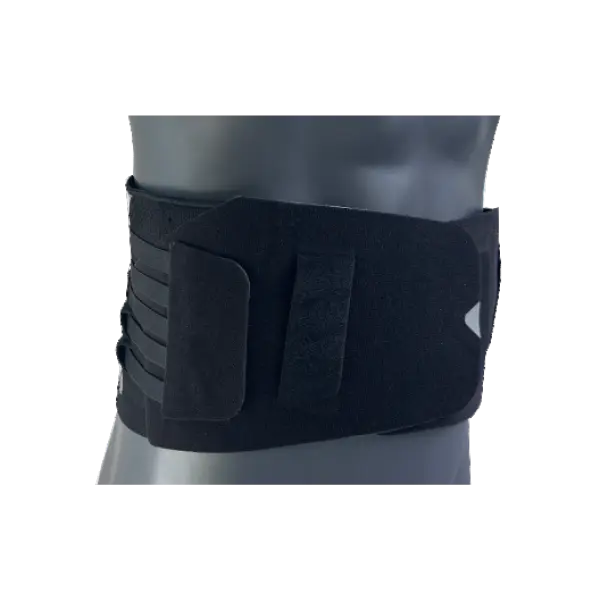
The sequence that many desk workers experience without realizing it:
The problem is not that people are sitting incorrectly out of laziness. It is that the muscular endurance required to maintain neutral posture across a full workday is greater than what many sedentary workers have developed — and the chair itself provides no feedback when posture drifts.
The mechanism is more specific than general back pain marketing suggests. Understanding it helps in evaluating what to look for when choosing support for office use.
A well-designed Elastic Waist Support addresses three overlapping functions:
The support applies gentle inward pressure at the lower back, maintaining or partially restoring the lumbar lordosis that typically flattens during prolonged sitting. This reduces the mechanical disadvantage of the rounded-back posture and keeps disc loading within a more manageable range.
The physical contact of the support against the lower back creates a postural awareness signal that many people are not generating independently. When the wearer's posture starts to drift, the pressure distribution across the support changes — providing a gentle reminder to reposition rather than continuing the drift toward increasing load.
Controlled compression around the waist and lower back reduces the micro-movement and shear forces in the lumbar joints that accumulate during sustained sitting. This is particularly relevant for people who shift positions frequently or who work at desks with seated tasks that involve twisting or reaching.
Rigid back supports serve a different function — they are designed for acute injury management, post-operative recovery, or heavy labor protection. Office work asks for something different.
An office setting involves varied postures across a day: forward reach to a keyboard, leaning back during calls, turning to address colleagues, and transitional movements between seated and standing positions. A rigid support that holds one position well is poorly suited to this variation.
An Adjustable Waist Support addresses this through:
The alternative — a single-tension, fixed-fit support — works at one point in the day and feels too tight or too loose at others. That inconsistency is why many people abandon supports after a few days of use rather than building the consistent wear habit that actually produces results.
A Comfortable Waist Support that gets used every day delivers greater benefit than a technically advanced support that gets left in the desk drawer after the third wearing.
Breathability in lumbar supports matters because:
A Breathable Lumbar Support uses mesh panels, perforated materials, or moisture-wicking fabric in contact zones to allow air circulation while maintaining structural support where it is needed. The tradeoff between breathability and support compression is a real engineering consideration — supports that sacrifice too much structure for ventilation do not provide adequate lumbar stabilization, while supports that prioritize rigidity create the heat accumulation problem described above.
For all-day office wear, the balance point favors breathability at the contact surfaces with firmer support at the lumbar panel.
Not every support marketed for office use is actually designed for office use. A few specific characteristics distinguish a support suited to prolonged sitting from one designed for more physically demanding applications.
The lumbar pad or panel should cover the L4-L5 region of the lower spine — the area that carries the greatest load during sitting. A panel that is too low supports the sacral region instead; one that is too high provides thoracic rather than lumbar support.
What to look for:
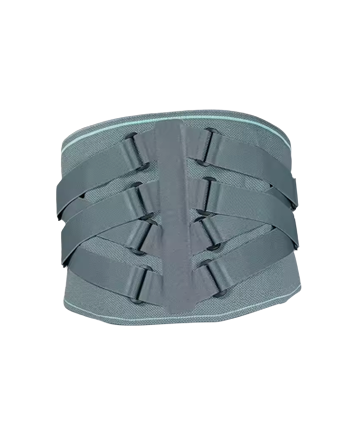
The closure system determines how accurately compression can be adjusted across the day. Velcro closures allow fine adjustment but degrade with repeated use. Dual-pull side panels allow symmetric tension adjustment. Wrap-around designs that cross the front provide even compression but take longer to adjust.
For office use specifically:
The materials that contact the lower back and abdomen directly should be soft, non-abrasive, and moisture-managing. Stiff or rough materials at contact zones become uncomfortable quickly and create the skin irritation that causes early wear abandonment.
| Support Type | Lumbar Stabilization | Adjustability | Breathability | Suited to Office Use |
|---|---|---|---|---|
| Elastic Waist Support with lumbar pad | Moderate to high | High | Moderate to high with mesh | Yes |
| Rigid back brace | High | Low | Low | Not for all-day wear |
| Soft wrap belt | Low | Moderate | High | Partial — limited stabilization |
| Posture correction vest | Upper back focus | Low | Moderate | Partial — limited lumbar focus |
| Contoured lumbar cushion (chair-mounted) | Lumbar curve only | Positional only | High | Complementary to worn support |
The Elastic Waist Support with an integrated lumbar pad sits at a practical point for office applications — providing enough stabilization to address the postural drift problem while remaining adjustable and comfortable enough for continuous wear.
Wearing a support incorrectly reduces its effectiveness and can create secondary discomfort. A few practical guidelines apply to office wearing specifically.
Positioning:
Compression level:
Duration:
For procurement managers, corporate wellness buyers, and Waist Support Factory partners sourcing at volume, a few considerations go beyond the individual user perspective.
Practical considerations for bulk specification:
For people who spend many of their working hours seated, lumbar discomfort is less an inevitable consequence of desk work and more a signal that the mechanical load on the lower back is going beyond what the body manages without support. An adjustable, breathable waist support designed for extended office use addresses that load directly — reducing the postural drift that accumulates across a day, providing proprioceptive feedback that many chairs do not, and doing so in a format comfortable enough to actually use consistently rather than briefly. Zhejiang Steriger Sports Medicine Technology Co., Ltd. produces waist supports and lumbar braces designed for active, all-day wear across a range of office, work, and rehabilitation applications. If you are evaluating waist support options for workplace wellness programs, volume procurement, or private label supply, reaching out with your specific requirements — size range, volume, feature priorities, and customization needs — allows the team to recommend a configuration matched to your program rather than a generic catalog selection.
Steriger is a national high-tech enterprise specializing in the R&D and production of high-quality sports supports, medical braces, and sports compression socks.
Copyright © Zhejiang Steriger Sports Medicine Technology Co., Ltd.
The information provided on this website is intended for use only in countries and jurisdictions outside of the People's Republic of China.

Approval No: 浙金药监械生产备20200039号

 English
 Español
 Deutsch
 عربى
عربى Français